2026 Emerging Technology Trends
Adopting Continuous Exposure Management and multi-agent Autonomous Threat Analysis

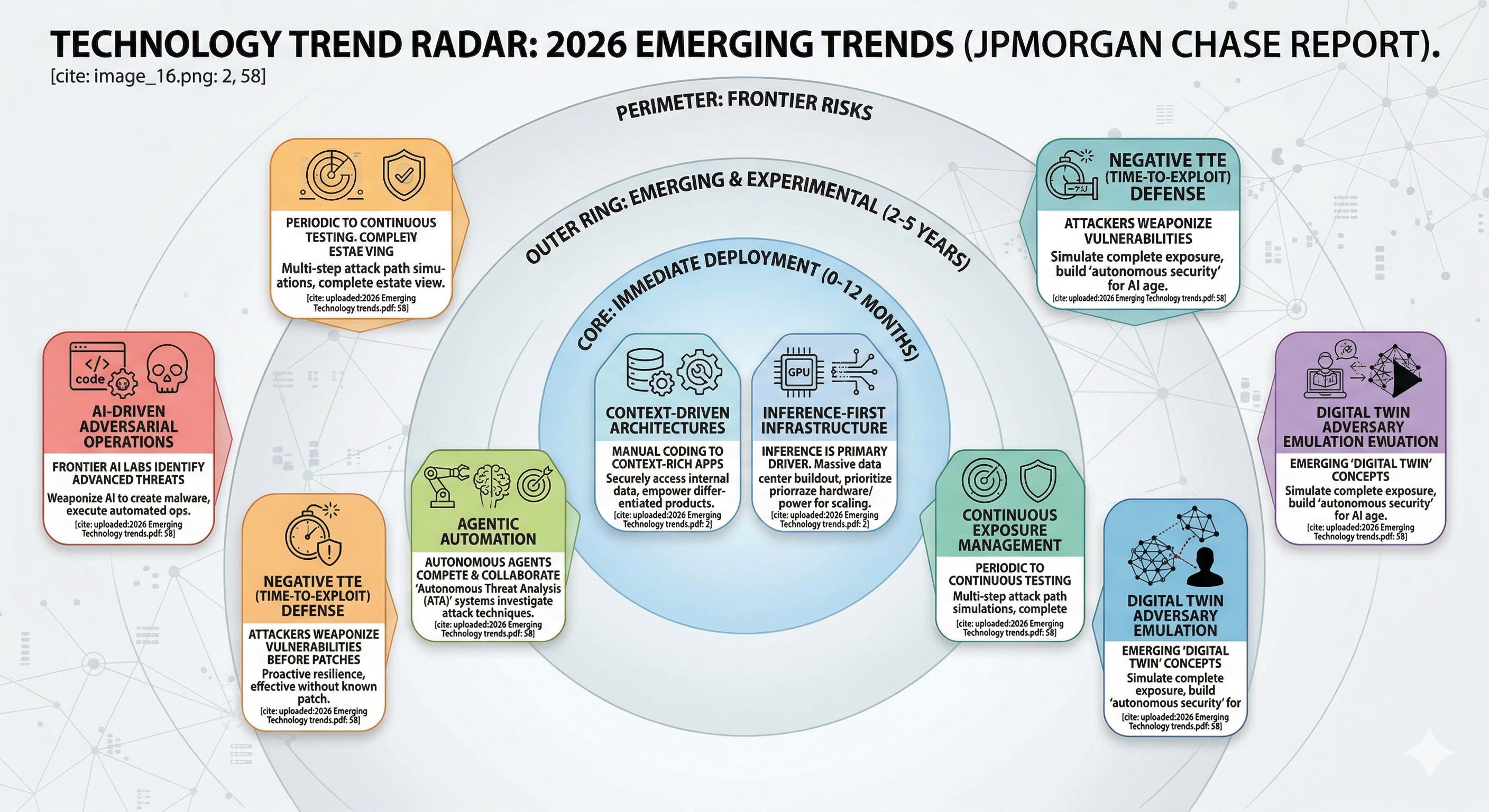
Based on the JPMorgan Chase "2026 Emerging Technology Trends" report, the core strategic focus for enterprises is the urgent transition from manual coding to architecting "context-driven" applications and "inference-first" infrastructure to unlock the full potential of AI agents.
This shift requires a massive re-engineering of data center design and power management to sustain the AI inference demand. Crucially, the rise of "Al-Driven Adversarial Operations"has accelerated the threat landscape to the point where defensive innovation must occur on the radar's edge to counter a "Negative Time-to-Exploit (TTE)" environment, where attackers weaponize vulnerabilities before patches exist.
The report advocates for adopting Continuous Exposure Management and multi-agent Autonomous Threat Analysis to build a proactive, resilient posture capable of navigating the complex interplay between innovation and frontier risks.

The Trend Radar analysis categorizes the identified shifts by their operational impact and maturity, moving from the core infrastructure to the outer edges of adversarial innovation.
1. Core: Immediate Deployment (0–12 Months)
Context-Driven Architectures: The most immediate shift is moving from manual coding to architecting “context-rich applications.” Success now depends on enabling AI agents to securely access the most relevant internal data to empower differentiated products.
Inference-First Infrastructure: Demand for AI inference is driving a massive buildout in data center design. Organizations are prioritizing the hardware and power required to run models at scale rather than just training them.
2. Inner Ring: Accelerating Adoption (1–2 Years)
Agentic Automation: AI is moving from simple assistants to “autonomous agents” that compete and collaborate. Systems like “Autonomous Threat Analysis (ATA)” use multiple agents to investigate attack techniques and propose security controls for human review.
Continuous Exposure Management: Security is shifting from periodic scanning to “continuous exposure testing.” Incumbents are integrating multi-step attack path simulations to provide a complete view of an organization’s estate from an attacker’s perspective.
3. Outer Ring: Emerging & Experimental (2–5 Years)
Negative Time-to-Exploit (TTE) Defense: A critical emerging trend where attackers weaponize vulnerabilities before patches exist. This requires a new “proactive resilience” model where defense must be effective even without a known patch.
Digital Twin Adversary Emulation: Emerging startups are creating “digital twin-like concepts” to simulate a complete picture of organizational exposure. The end goal is “autonomous security” built specifically for the age of AI.
4. Perimeter: Frontier Risks
Al-Driven Adversarial Operations: Frontier AI labs have identified that advanced threat actors are already using AI tools to create malware and execute sophisticated, automated operations. This represents the “edge” of the radar where innovation and threat are most tightly coupled.
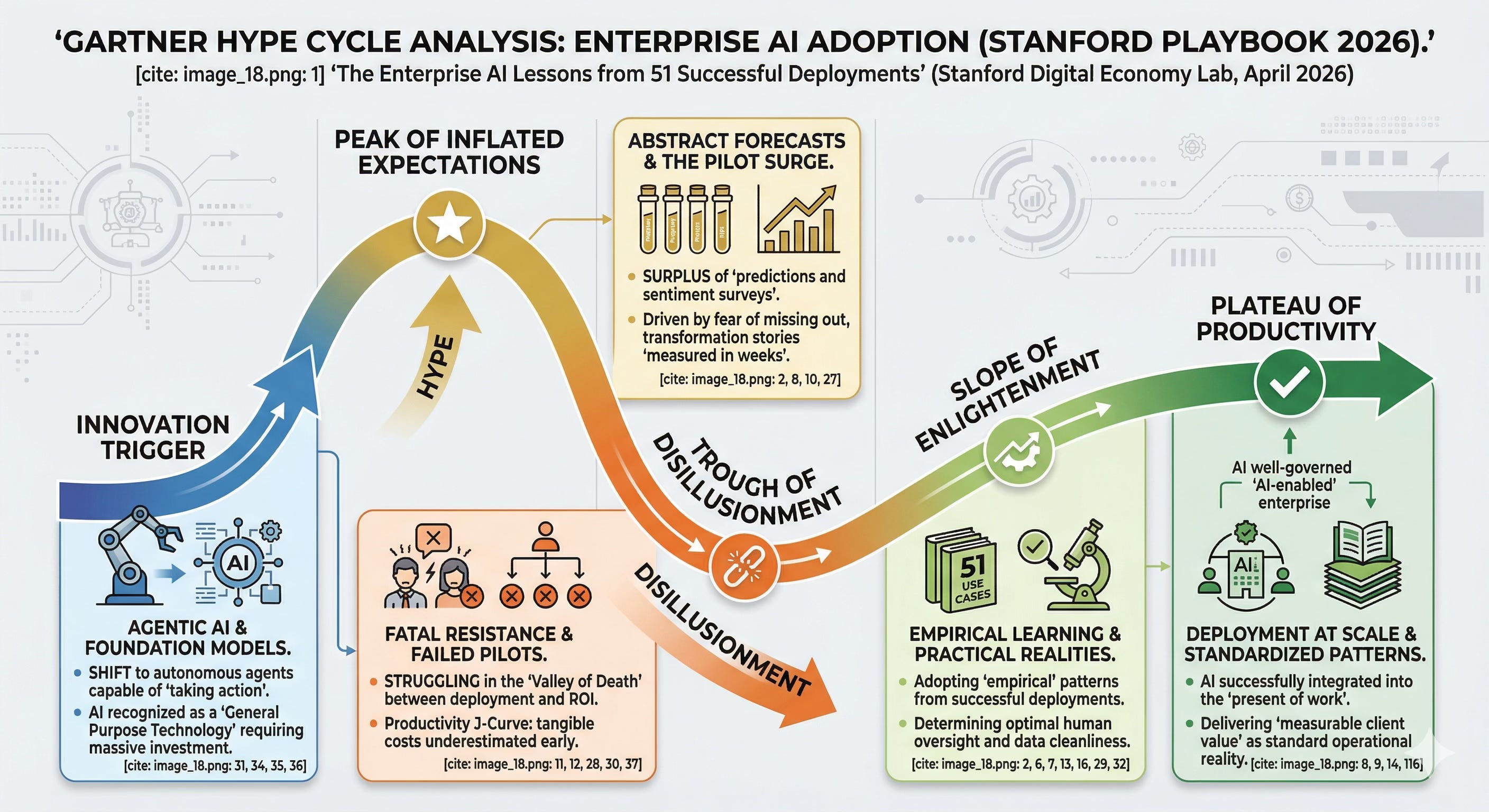
The following Hype Cycle analysis evaluates the current maturity of AI adoption within the corporate sector.
1. Innovation Trigger
Agentic AI & Foundation Models: The primary trigger is the shift from “tools that only answer questions” to autonomous agents capable of taking action within enterprise systems.
General Purpose Technology (GPT) Status: AI is now recognized as a GPT that requires massive complementary investments in process redesign and workforce development.
2. Peak of Inflated Expectations
Abstract Forecasts: The report notes a “shortage” of empirical data, replaced by a “surplus of predictions and sentiment surveys” that often overestimate immediate impact while underestimating long-term structural needs.
The “Pilot” Surge: Many organizations are currently in the phase of “just experimenting,” driven by the fear of missing out on transformation stories often “measured in weeks”.
3. Trough of Disillusionment
The “Valley of Death”: A critical phase identified where organizations struggle to bridge the gap between initial deployment and actual ROI.
Fatal Resistance & Failed Pilots: Disillusionment stems from “fatal resistance” within the organization and the realization that the difference in outcomes is rarely the AI model, but the organization’s “readiness, processes, and leadership”.
The Productivity J-Curve: This macroeconomic model explains why productivity growth is “systematically underestimated” in early years as firms struggle with intangible costs before seeing benefits.
4. Slope of Enlightenment
Empirical Learning: Organizations are beginning to move forward by studying “real-world use cases” and the “patterns of those who have already walked the path”.
Practical Realities over Abstract Frameworks: Success is found by focusing on “what is happening right now,” such as determining the optimal level of human oversight and data cleanliness.
5. Plateau of Productivity
Deployment at Scale: The final stage where AI is successfully integrated into the “present of work,” delivering “measurable client value” as a standard operational reality.
Standardized Implementation Patterns: At this stage, the “nuances that separate a successful pilot from a failed one” are well-understood and codified into enterprise playbooks.
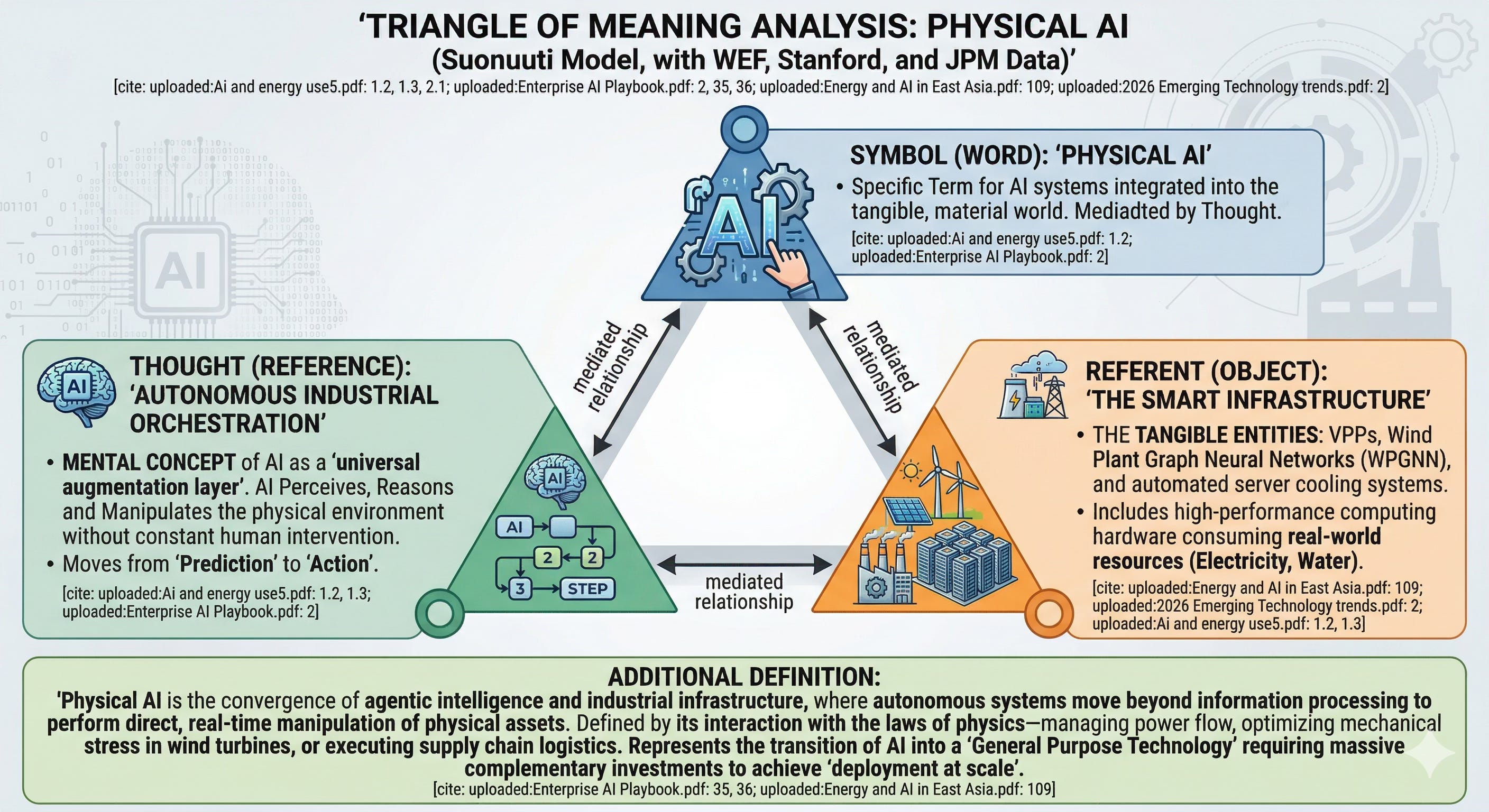
In addition especially for physical AI a triangle of meaning analysis could make sense.
The Triangle of Meaning (Ogden & Richards) illustrates that the relationship between a word and the thing it describes is mediated by thought.
Triangle of Meaning: Physical AI
The Symbol (Word): “Physical AI”
This is the specific term used to describe AI systems that are no longer confined to digital screens or text generation but are integrated into the tangible, material world.
The Thought (Reference): “Autonomous Industrial Orchestration”
This represents the mental concept of AI as a “universal augmentation layer”. It is the idea that AI can perceive, reason about, and manipulate the physical environment—such as balancing a power grid or managing a warehouse—without constant human intervention. It moves the concept of AI from “prediction” to “action”.
The Referent (Object): “The Smart Infrastructure”
These are the actual physical entities: Virtual Power Plants (VPPs), Wind Plant Graph Neural Networks (WPGNN), and automated server cooling systems. It includes the “Inference-First Infrastructure” consisting of massive data center buildouts and high-performance computing hardware that consumes real-world resources like electricity and water.
Additional Definition
Physical AI is the convergence of agentic intelligence and industrial infrastructure, where autonomous systems move beyond information processing to perform direct, real-time manipulation of physical assets.
Unlike “Digital AI,” which focuses on content generation or data analysis, Physical AI is defined by its interaction with the laws of physics—managing power flow, optimizing mechanical stress in wind turbines, or executing supply chain logistics. It represents the transition of AI into a “General Purpose Technology” that requires massive “complementary investments” in physical hardware and energy systems to achieve “deployment at scale”.