
Accelerating scientific research
Uncertainty and Opportunities

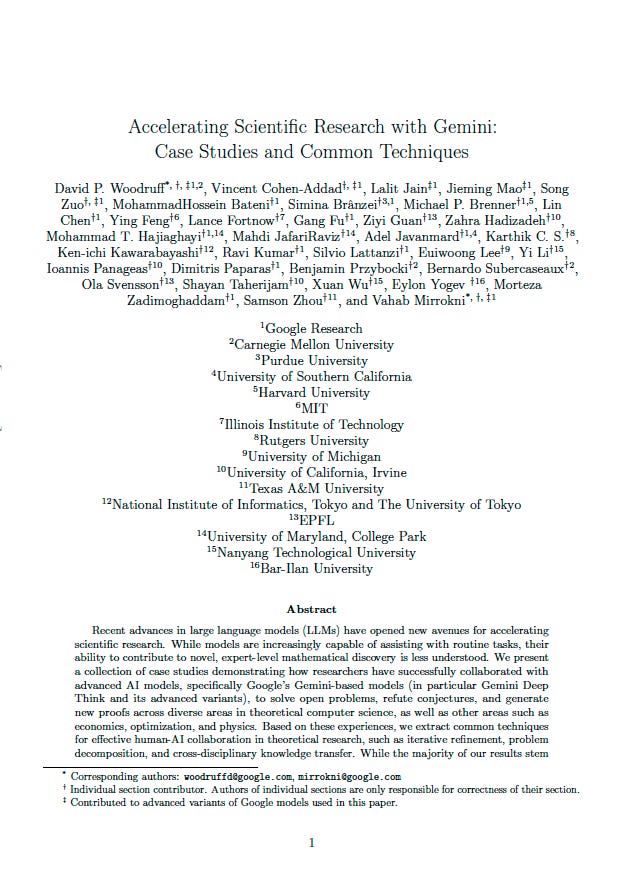
This document, “Accelerating Scientific Research with Gemini: Case Studies and Common Techniques,” provides a comprehensive overview of how Large Language Models (LLMs) can be integrated into the workflow of professional scientific research, particularly in fields like computer science, mathematics, and economics.
Core Summary
The paper details several case studies where Gemini was used to assist in high-level scientific tasks, such as:
Formal Verification: Assisting in writing Lean proofs for complex mathematical problems.
Literature Reviews: Synthesizing vast amounts of existing research into cohesive summaries.
Algorithm Design: Generating and refining code for complex computational problems.
Data Analysis: Identifying patterns in large datasets that might be missed by manual human review.
Focus on Uncertainty
In the context of scientific AI, uncertainty is the central challenge that researchers must manage. The document outlines how scientists can navigate the “unreliable” nature of AI to produce rigorous results.
The Uncertainty of Hallucinations: The primary source of uncertainty is the model’s tendency to produce “hallucinations”—plausible-sounding but factually incorrect statements. The paper emphasizes that scientific AI should not be used as a “source of truth” but as a co-pilot whose outputs must be verified.
Prompt Engineering to Reduce Uncertainty: The authors detail specific techniques to make AI outputs more predictable and certain:
Chain-of-Thought (CoT) Prompting: Asking the AI to show its “step-by-step reasoning” reduces the uncertainty of the final answer by allowing humans to check the logical path.
Few-Shot Prompting: Providing a few correct examples within the prompt to narrow the AI’s “possibility space” and ensure the output follows a specific, certain format.
Managing Model Stochastics: Because AI is “stochastic” (probabilistic), the same prompt might yield different results at different times. The paper discusses the importance of temperature settings—lower temperatures reduce uncertainty by making the model more deterministic and “conservative” in its word choices.
Strategic Approaches to Uncertainty
The document suggests two main strategies for dealing with the inherent uncertainty of generative AI in research:
Iterative Refinement: Rather than asking the AI for a final solution (which is highly uncertain), researchers should use a “conversation” approach. Each step reduces the uncertainty of the next by providing more context and correction.
Human-in-the-Loop (HITL): This is the ultimate tool for resolving AI uncertainty. The paper argues that AI should be used for breadth (exploring many ideas) while humans are used for depth (the certain verification of those ideas).
Conclusion
The document concludes that while AI introduces new types of uncertainty into the research process, it also provides the tools to manage it. By combining the “raw creative power” of the LLM with rigorous “human verification,” scientists can accelerate discovery while maintaining the absolute certainty required for peer-reviewed research.