
Artificial Intelligence
Triangle of Meaning Analysis (under development)

The following analysis looks at the Triangle of Meaning concerning Artificial Intelligence.
Structural Mapping of the Vertices (The Citizen’s Emotional Baseline)
To address and alleviate public anxiety regarding the rapid advancement of automation, we must break down the core concept using the semiotic triangle, separating public rhetoric from the physical, bounded reality of computer science:
The Symbol (Signifier): The citizen is constantly exposed to the blanket term “Artificial Intelligence” (AI), amplified by clickbait headlines (“AI Has Achieved Sentience and Will Replace All Human Labor”), tech-evangelist hype (“Artificial General Intelligence is Imminent”), and dystopian science-fiction media depicting autonomous, omniscient digital entities.
The Thought / Reference (The Internalized Fear): In the citizen’s mind, this symbol triggers an existential and paralyzing mental model. The internalized fear manifests as an unstoppable force: a looming future where their professional skills become entirely obsolete, an invisible algorithmic oracle that automates away their privacy, and an omnipresent system that robs them of personal agency, rendering human creative and analytical thought meaningless.
The Referent (Object/Physical Reality): The actual, real-world reality consists of complex mathematical models executing statistics at scale. The empirical referent is bounded by matrix multiplication, pattern-matching algorithms, large language model (LLM) weights, massive server data centers, immense electrical grid dependencies, lack of true semantic understanding or consciousness, and rigid code boundaries that only function within deterministic data parameters.
Tri-Axis Disconnect & The Architecture of Fear
Analyzing the lines of tension across the citizen’s semantic triangle exposes how a lack of structural clarity fuels psychological anxiety:
                      [Thought / Reference]
                    (Internalized Existential Dread:
                     Total Displacement & Surveillance)
                           /        \
                          /          \
              Symbol-    /            \    Referent-
              Thought   /              \   Thought
         (Hype/Sci-Fi) /                \ (Shadow Gap)
                      /                  \
                     /                    \
               [Symbol] ------------------ [Referent]
             ("Artificial Intelligence")   (Statistical Models, Compute Costs,
                                            Data Curtains, Hardware Limits)
                                  ▲
                       [SYMBOL-REFERENT AXIS]
                    Abstract terminology oversimplifies
                     brittle engineering boundaries.
The Symbol-Thought Axis (The Amplification Gap): Corporate marketing and sensationalist news exploit cognitive biases by using anthropomorphic language like “learning,” “thinking,” and “understanding” to describe machine logic. By applying human cognitive labels to software, the language primes the consumer’s mind (Thought) to assume the software possesses human-like intent, consciousness, and adaptability. This creates an immediate expectation gap, causing the citizen to view standard software packages as sentient competitors.
The Referent-Thought Axis (The Shadow Gap): Because the public rarely interacts with the raw code, data matrices, or engineering bottlenecks under the hood, their fear projects an “all-powerful, infallible machine.” The shadow gap conceals the profound vulnerabilities of the physical Referent. The citizen imagines a flawless digital mind, remaining completely unaware that these systems are highly fragile, prone to severe “hallucinations,” completely dependent on cleanly labeled human training data, and unable to reason outside of their pre-existing datasets.
The Symbol-Referent Axis (The Disempowerment Boundary): The abstract narrative pushed in public discourse completely decouples from localized, physical constraints. Public figures speak of “AI” as an ethereal, omnipresent cloud force. This abstract boundary hides the reassuring physical reality: code requires immense energy, silicon, water, and hardware maintenance to exist. It is a highly localized, infrastructure-heavy physical operation that can be regulated, bottlenecked, and structurally constrained by human-scale actions.
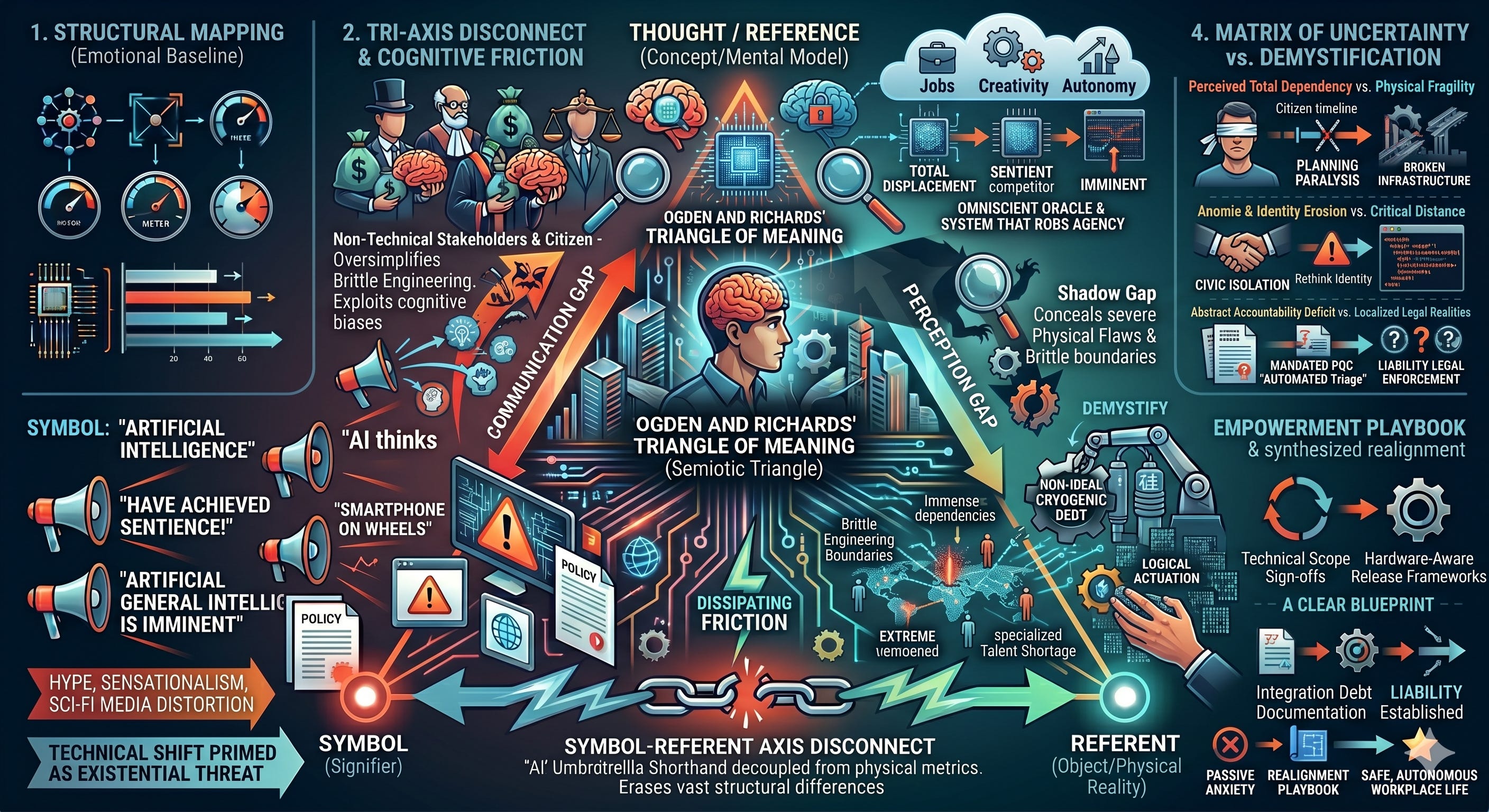
supported by Gemini
Matrix of Uncertainty vs. Demystification
Contrasting abstract anxieties against the physical and structural limitations of current technology allows us to dismantle the citizen’s fear and uncover areas of personal control:
Perceived Total Dependency vs. Physical Fragility
The Perceived Threat: The citizen fears that AI is an all-knowing, omnipotent network that will seamlessly infiltrate and automate every layer of modern society, leaving no room for human intervention.
The Decoded Reality: In reality, modern AI infrastructure is highly fragile, resource-constrained, and financially volatile. Training and running advanced models requires astronomical amounts of electricity, clean water for data center cooling, and a continuous supply of specialized semiconductor chips. Furthermore, these systems are fundamentally limited by the “data wall”—the looming exhaustion of high-quality, human-generated internet data required for training. Understanding that AI is an infrastructure-heavy, resource-starved machine strips away its phantom omnipotence, revealing a system vulnerable to energy constraints, hardware bottlenecks, and data shortages.
Anomie & Identity Erosion vs. Critical Distance
The Perceived Threat: The citizen suffers from a sense of erasure, believing that software models can replicate human thought, creativity, and empathy perfectly, making human identity redundant.
The Decoded Reality: Interfacing with modern AI applications reveals a persistent pattern of errors, fabrications, and rigid mechanical output. Systems frequently hallucinate false legal citations, invent historical facts, and fail at basic logic puzzles because they are predicting the next most probable word or pixel rather than comprehending reality. Observing these mundane, glitch-ridden outputs allows the citizen to establish critical distance. These flaws prove that the software lacks consciousness, genuine comprehension, and critical reasoning. This structural limitation reinforces the irreplaceable value of authentic human judgment, emotional intelligence, and lived experience.
Abstract Accountability Deficit vs. Localized Legal Realities
The Perceived Threat: The citizen worries that automated algorithms will make life-altering decisions about their credit, employment, or legal rights in a lawless digital frontier without human recourse.
The Decoded Reality: No algorithmic tool operates in a legal vacuum. AI deployment is increasingly constrained by concrete legal frameworks, corporate compliance guidelines, data-privacy statutes (such as GDPR and CCPA), and evolving copyright laws. Courts are consistently ruling that developers are liable for the output and biases of their models. Furthermore, localized workplace agreements, consumer protection laws, and professional licensing boards require human-in-the-loop validation for high-stakes decisions in medicine, law, and civil infrastructure. These heavily enforced legal boundaries ensure that algorithms remain subordinate to human legal frameworks.
Civic Synthesis & The Empowerment Playbook
To overcome psychological paralysis and build resilience, the individual citizen must shift from a passive, anxious observer into an active, literate auditor of technology:
Demystify the Symbol through Functional Literacy: Neutralize the Symbol-Thought axis by removing anthropomorphic language from your vocabulary. Stop referring to software models as “thinking” or “knowing.” Reframe them accurately in your mind as “advanced statistical prediction engines” or “automated pattern-matchers.” Stripping the magical nomenclature away resets your mental model to view the technology as a tool rather than a sentient threat.
Audit Personal Dependency Loops and Cultivate Analog Mastery: Protect your cognitive autonomy from algorithmic dependency by maintaining sharp, offline skills. Intentionally solve complex problems, draft communications, and engage in creative tasks without the assistance of automated tools. By treating generative software as an optional editing assistant rather than a primary thinker, you maintain your unique cognitive edge and eliminate the fear of systemic displacement.
Exploit the Glitches to Build Confidence: Actively test and probe the boundaries of the digital tools available to you. Push models to their logical limits by introducing complex, non-linear problems, or asking for highly localized, nuanced contextual analysis. Forcing the system to display its mechanical limitations and hallucinations breaks the illusion of its infallibility, reinforcing your confidence in your own critical thinking and validation skills.
Enforce Precise Boundaries and Demand Human Intermediation: Assert your consumer and civic rights by actively refusing blind algorithmic management. When dealing with insurance, banking, employment applications, or medical triage, explicitly ask companies whether automated tracking or algorithmic sorting is being utilized. Where available, exercise your legal right to demand a human review of automated decisions. Forcing organizations to provide human accountability anchors the technology to human standards, securing your personal peace of mind and autonomy.